PKI Connectors
Description
A "PKI Connector" is a configuration piece that allows to establish the communication with any supported PKI. Additionally, it enables to map a specific certificate profile within the connected PKI.
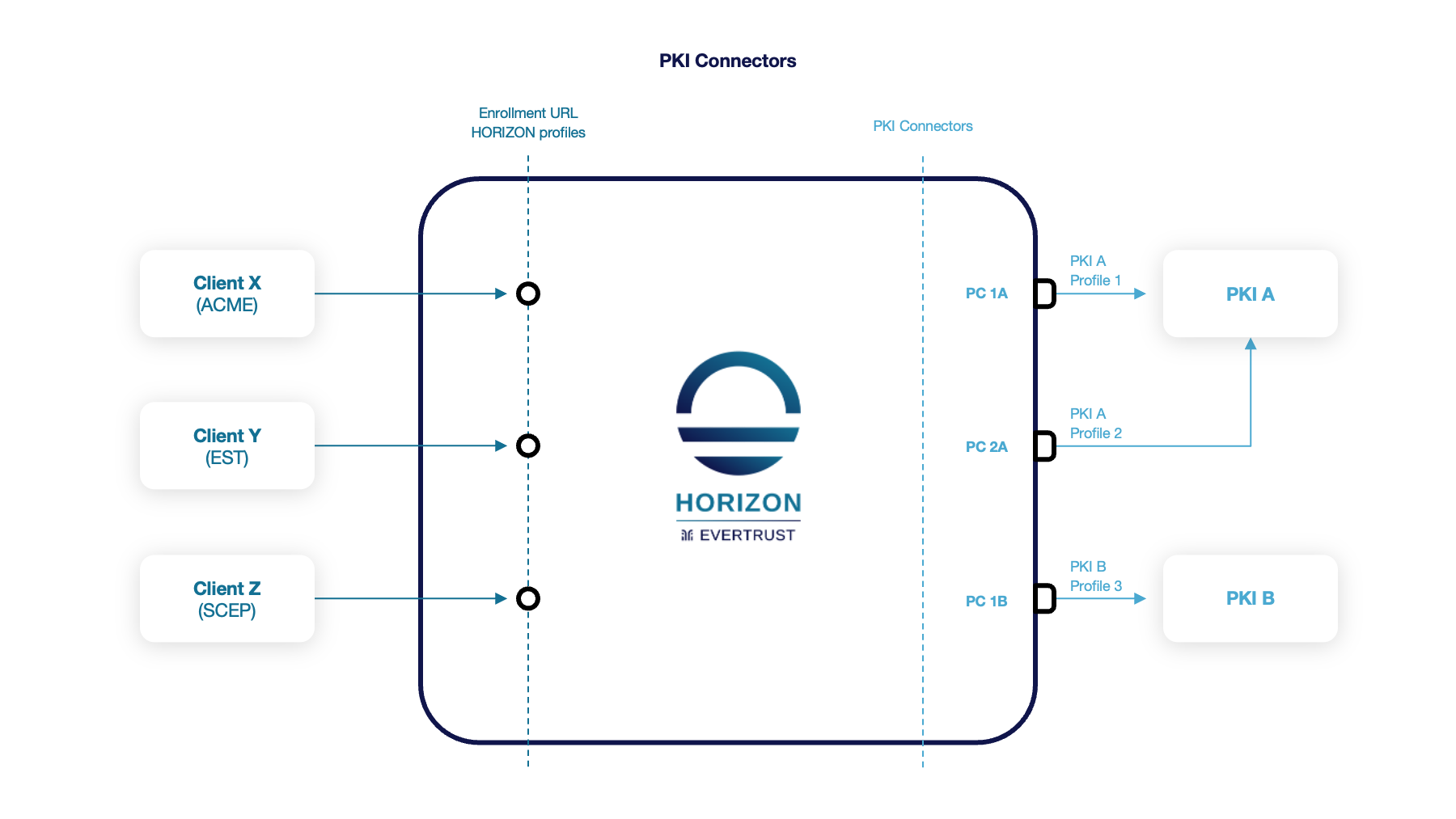
Common prerequisites
To grant "Horizon" proper access to a given PKI, three categories of requirements must be gathered:
-
Credentials: It could be either certificates (PKCS#12 format) or technical accounts (login/password) allowing to authenticate against the PKI API.
-
Permissions: The credentials must be granted with the proper permissions on the PKI in order to be able to manage certificate lifecycle (enroll, revoke, renew).
-
Profile/Certificate information: This information is used to map certificate types and/or certificate fields.
Asynchronous certificate lifecycle
Some PKIs cannot return a certificate within Horizon’s synchronous request timeout, typically because they require an extended validation (manual review, email or phone confirmation, …). Connectors that support asynchronous issuance let Horizon return a non-final request status, then resume the lifecycle in the background.
When a request has been submitted, but no certificate has yet been delivered, it is In Progress. The request is polled periodically by a background process until the certificate is available or the order is canceled. As the requester, an in_progress request can be canceled. As an approver, it can be denied. Either action cancels the underlying order on the PKI.
| Asynchronous behavior is only used by enrollment workflows that opt in to it (currently WebRA enroll and renew). Protocol-driven workflows (ACME, SCEP, EST, …) still run in synchronous mode to preserve their existing semantics. |
At enrollment time, Horizon first performs a short synchronous polling cycle within the connector’s configured timeout. If a certificate is returned during that window, the request completes as usual. Otherwise, the request is switched to in_progress and a background process takes over.

Once a request is in_progress, a background actor polls the PKI on the schedule defined by horizon.async-poll.interval (default: every 5 minutes). Retry intervals grow in 5-minute increments up to one hour. A successful poll updates the certificate; a transient error logs an event and reschedules the next poll; a fatal error switches the request to failed.
Public PKI reissue
To accommodate the gap between order lifetime (typically one year) and the reduced certificate lifetime imposed by the CA/Browser Forum (200 days, decreasing toward 47 days), public PKI connectors that support it now reissue a certificate on the same order during renewal instead of creating a new order, as long as the order is still valid.
The behavior is automatic and transparent:
-
on renewal, if the connector reports an order expiration metadata (
PKI_ORDER_EXPIRATION) and the order is not in its renewal period, Horizon issues areissueagainst the existing order and inherits the original order expiration; -
if the order is in its renewal period, or if the connector does not expose an order expiration, Horizon falls back to a classic enroll, which creates a new order on the PKI.
From Horizon 2.10.7, Nameshield fetches thePKI_ORDER_EXPIRATIONmetadata on renewal even if it is not present on the certificate being renewed.
This guarantees that the certificate issued by a renewal is never already in its renewal period, and that subscriptions are consumed through to their end.
| This feature is only available for certificates enrolled after version 2.10.0. Certificates enrolled before this version will not see their order reissued even if they still have validity time available. |

|
Connectors with reissue support are:
|